Stop Sending the Same CV Everywhere: How to Pass AI Resume Screening in 2026
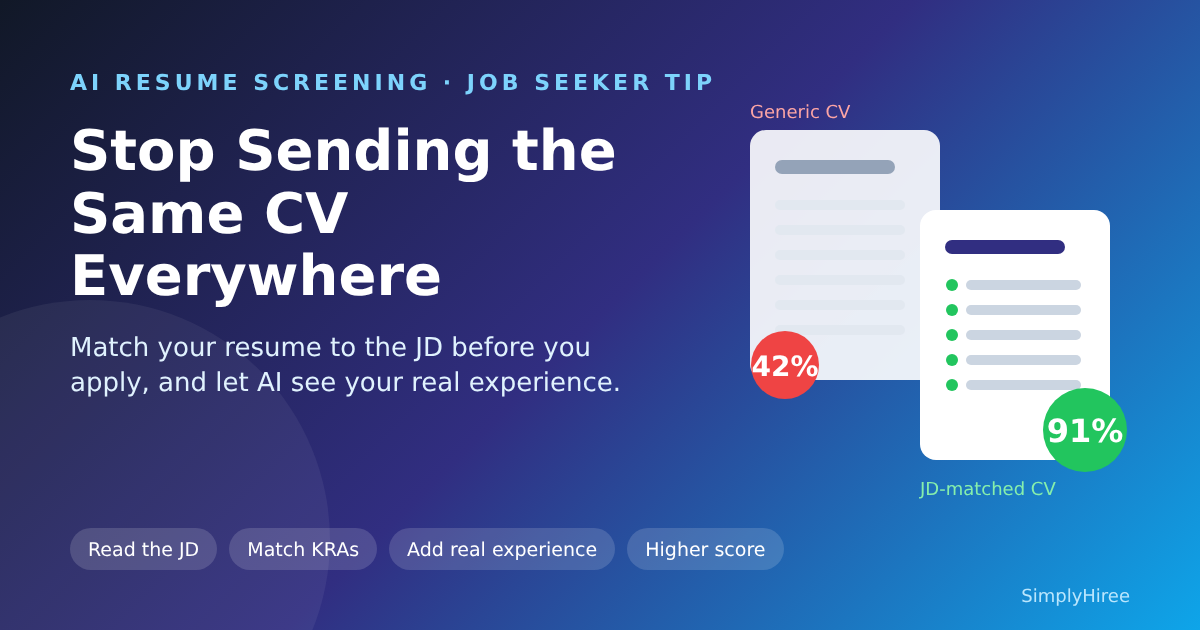
Today, almost everyone is applying for jobs online. You see a job title that looks right, click "Apply", and upload the same standard CV you have been using for months. You do this for ten, twenty, maybe fifty jobs, and then you wait. Very often, nothing comes back.
The problem is usually not your experience. The problem is that your resume is not telling the right story for that specific job, and in the AI era that mistake costs you the shortlist.
How AI resume screening works
Many companies and recruiters now use AI tools to screen resumes before a human ever looks at them. The AI reads the job description (JD), especially the KRAs (Key Result Areas), key responsibilities and required skills. Then it reads your resume and checks how closely it matches. Based on this, it gives your profile a matching score.
If your resume clearly shows the skills and experience the JD is asking for, your score goes up. If it does not, your score goes down, even if you actually have that experience.
Why good candidates get rejected
Here is the hard truth: AI can only judge what is written in your resume. It cannot guess.
Say a JD asks for "vendor management" and "inventory control". You have handled both in your last job, but your resume only says "Operations Executive – handled daily operations". The AI does not see the match, so it gives you a low score. Your profile drops down the list, and a candidate with less experience but a better-written resume gets shortlisted instead.
Recruiters do review some profiles manually, but that is becoming rare. Many employers now rely mainly on AI scoring and only look at the most relevant, highest-scoring CVs. If your resume does not make it past the AI, a recruiter may never see it.
What to do before you upload your CV
1. Read the JD carefully
Before applying, read the full job description, not just the title. Note the main KRAs, responsibilities, required skills, tools and qualifications.
2. Match your real experience to the JD
Go through each key requirement and ask yourself: "Have I done this?" If yes, make sure it is clearly written in your resume. Many people have the right experience but simply forget to mention it.
3. Use the same words as the JD, where they are true for you
If the JD says "client onboarding", don't write only "helped new customers". If it says "MIS reporting", mention MIS reporting by name. AI tools look for these exact terms and closely related ones.
4. Put the most relevant experience at the top
Move the experience and skills that match the role into your summary and the top bullet points of each job. Don't hide your best match at the bottom of page two.
5. Show results with numbers
"Managed a team of 8 and reduced delivery delays by 20%" is much stronger than "Responsible for team management". Numbers help both AI and recruiters understand your impact.
6. Keep the format simple
Use clear headings (Summary, Skills, Experience, Education), standard fonts and plain bullet points. Avoid putting important information inside images, tables or graphics, because many screening tools cannot read them properly.
7. Keep a master CV and tailor a copy for each role
Maintain one detailed master resume with all your experience. For each application, make a copy and adjust the summary, skills and bullet points for that JD. It takes 10 to 15 minutes, and it can make a big difference.
One important rule: be honest
Tailoring your resume means highlighting the real experience you already have. It does not mean adding skills or work you have never done. Recruiters check during interviews and background verification, and false claims can cost you the job even after you are selected.
The result
When your resume clearly reflects the JD, AI screening understands your experience properly. You get a better matching score, you show up higher in the recruiter's list, and your chances of being shortlisted go up.
So the next time you are about to click "Apply", pause for a few minutes. Read the JD, update your CV for that role, and then upload it. Fewer, well-matched applications will almost always beat hundreds of blind ones.
Ready to apply smarter? Update your SimplyHiree profile and resume, and start applying to roles that truly match your experience.